The Blue Planet
Oceans make up 90% of the Earth’s biosphere and 80% of all living organisms, yet mankind has only explored 5% of the oceans.
Average ocean depth is 3700 meters (12,100 feet). This is a total volume of 1.35 billion cubic kilometers or 320 million cubic miles.
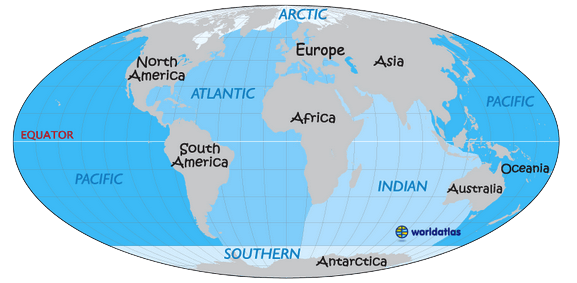
Five Oceans
Pacific Ocean, Atlantic Ocean, Indian Ocean, Arctic Ocean, Southern Ocean
The Pacific Ocean’s large vastness makes it essential for supporting life and regulating climate.
Worldwide about 90% of large predatory fish stocks like tuna and cod have already disappeared.
We harvest more fish each year than the ecosystem can naturally produce.
There were at least six times more fish in the sea in 1900 than in 2000.
Phytoplankton
Phytoplankton (microscopic marine plants) are so numerous in the ocean, they are responsible for the oxygen in every other breath we take. Phytoplankton form the base of the food chain in the ocean, serving as food for the zooplankton (microscopic marine animals) that in turn serve as food for fish and mammals in the sea.
The marine food web is an integral part of Earth’s climate system. This is because the most important chemical element for life, carbon, is also involved with regulating the temperature in the Earth’s atmosphere and the global heat balance.
Oceans in Trouble
Plastic Pollution

Plastics enter our oceans and break down into small fragments called micro-plastics. Aquatic life feed on these fragments.
The plastic debris is also circulated by currents accumulating large garbage patches full of plastic debris. These patches are referred to as gyres.
The plastic fragments are not only on the surface of the ocean, but throughout the water column.
Over-Fishing
One billion people count on seafood as a daily source of protein in their diet.
We harvest more fish each year than the ecosystem can naturally produce.
There were at least six times more fish in the sea in 1900 than in 2000.
Ocean Warming & Acidification
The heat trapping properties of CO2 in the atmosphere warm the Earth’s surface. Much of this excess heat gets absorbed into the oceans.
Phytoplankton and other ocean life depend on cold, nutrient-filled waters created from upward mixing from ocean depths.
Warming oceans means fewer nutrients are able to sustain the marine food web over time.
The oceans also absorb about a quarter of the excess CO2 in the atmosphere from fossil fuel emissions and other sources. CO2 acts as an acid when it dissolves in seawater, lowering its pH.
Many organisms in the ocean are sensitive to pH, or the acidity level, especially those that produce calcium carbonate shells, like mollusks and coral.
The ocean is already 30% more acidic today than it was 250 years ago and this is only increasing faster.